
I’ll Get to the Bookkeeping This Weekend
If you own a small business, there’s a good chance you’ve said it.
“I’ll get to the bookkeeping this weekend.”
And you probably meant it.
But then a customer needed something. An employee called out. You had a proposal to finish. Something broke. Something else became urgent.
Monday arrived and the bookkeeping was still there.
No problem. You’ll get to it next weekend.
And that’s usually how it starts.
Bookkeeping is remarkably good at waiting
That’s part of the problem.
Customers don’t wait quietly. Employees don’t. Vendors certainly don’t.
Bookkeeping does.
You can ignore it for a week and nothing terrible happens. Usually you can ignore it for a month and nothing terrible happens.
The business keeps running. Customers keep paying you. Bills get paid. There’s money in the bank.
So the bookkeeping gets pushed down the list again.
Eventually, you realize you haven’t really looked at the books in months.
And at that point, opening QuickBooks starts to feel a little like opening the garage door when you know you’ve been throwing stuff in there for three years.
You’re pretty sure everything is still in there.
You’re just not sure you want to see it.
Then somebody needs something
This is usually when bookkeeping suddenly stops being something you can put off until next weekend.
Your tax preparer wants the books.
The bank wants financial statements.
You’re applying for a loan.
You’re thinking about buying equipment or hiring another employee.
Or maybe business seems busy, but you’ve started wondering:
Are we actually making money?
Now you need answers.
And “I think we’re doing pretty well” isn't quite as useful as it used to be.
Being busy and being profitable aren't the same thing
This is another trap that's easy to fall into.
A business can have plenty of customers, lots of deposits hitting the bank and more work than it can handle—and still have surprisingly little left over at the end of the month.
The bank balance can give you a clue about how things are going.
It can't tell you the whole story.
At some point, most business owners want to know more than how much money happens to be in checking today.
They want to know whether the business is actually working.
The longer you wait, the bigger the job feels
Once you're behind, there's another problem.
Catching up isn't particularly appealing.
One month behind becomes three. Three becomes six.
Eventually, you've reached the point where you don't even know where to start.
That's when some business owners do what any reasonable person would do:
They close QuickBooks.
There. Problem solved.
At least until the tax preparer emails again.
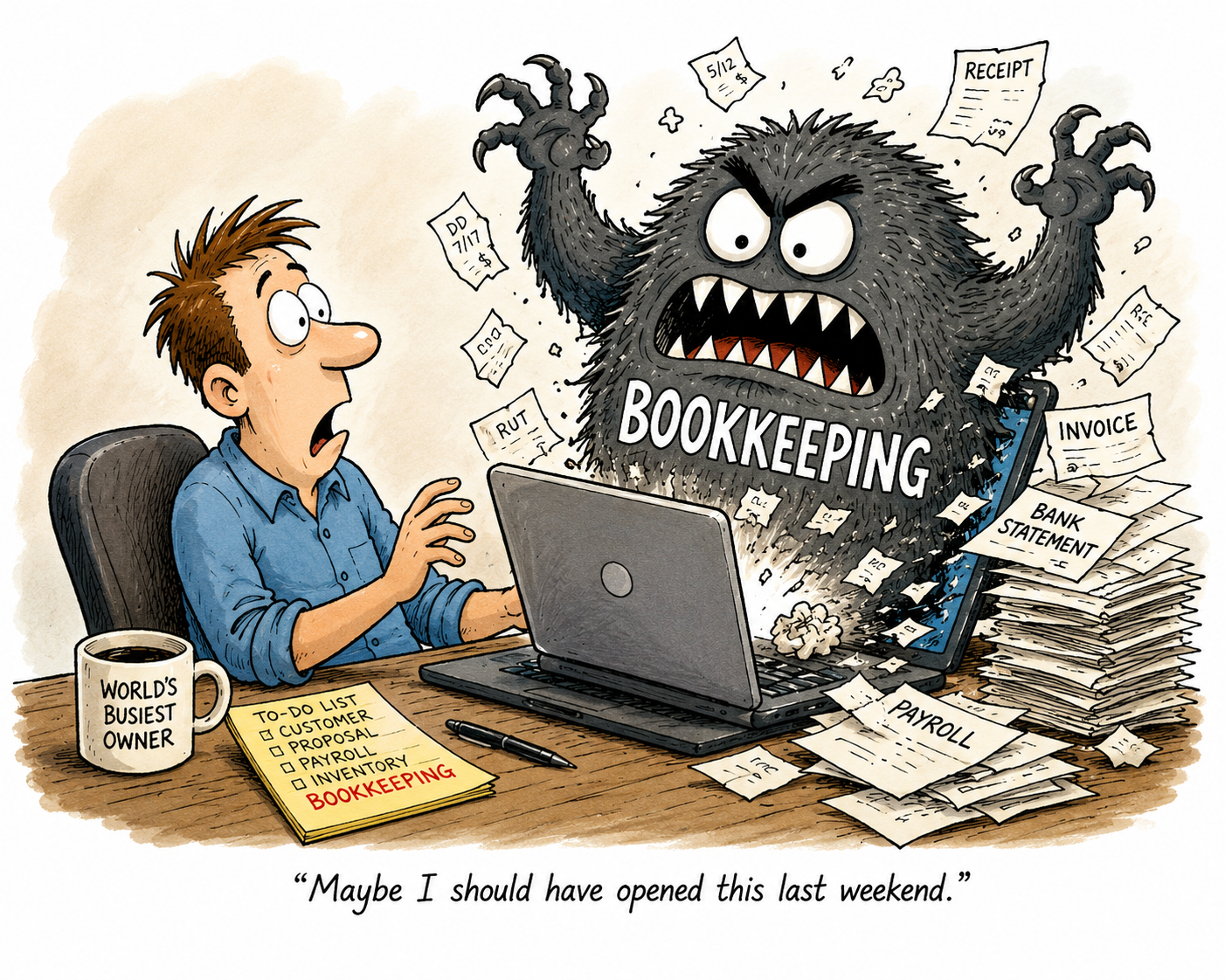
You didn't start a business to spend Sunday afternoon doing bookkeeping
This may be the most important part.
Most business owners are good at whatever caused them to start the business in the first place.
Maybe you're a contractor. A consultant. A retailer. You run a medical practice. You design things, sell things, repair things or build things.
Very few people start a business because they were looking for an excuse to reconcile a bank account on Sunday afternoon.
Early on, doing everything yourself makes sense.
But businesses change.
Eventually there are things you can continue doing yourself that may no longer be the best use of your time.
Bookkeeping is often one of them.
Sometimes the best business decision is handing something off
There's no prize for doing every job in your company yourself.
In fact, one of the nicer milestones in owning a business is realizing that you don't have to.
If the books have gotten away from you, you're hardly the first business owner that's happened to.
They can be caught up.
They can be cleaned up.
And, perhaps most importantly, they can become somebody else's thing to worry about.
Which means this weekend, you can find something better to do.